Why I Stopped Paying for Software
A personal take on SaaS and why I do what I do.
Why I Stopped Paying for Software I Only Used 10% Of (And Started Building My Own)
I didn’t set out to become a developer who builds custom web apps for small businesses. I set out to run my own business without losing my mind to subscription software, and building things myself turned out to be the only way to actually do that.
The subscription merry-go-round
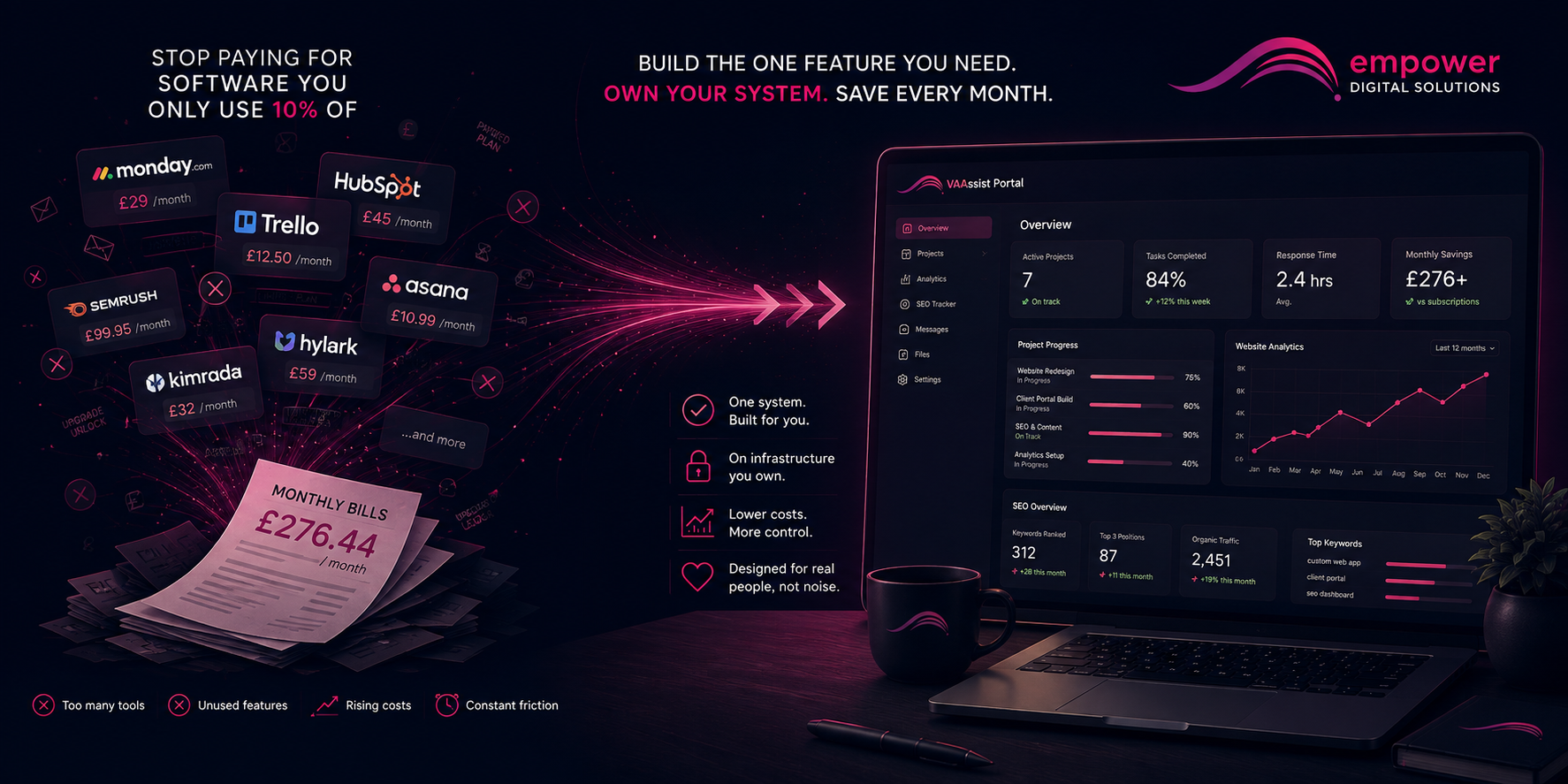
It started with Monday.com. Free trial, liked it, hit the paywall the moment I wanted to use the one feature that actually mattered to me. Fine, I thought, maybe it’s just that platform.
Then Trello. Same story. Then HubSpot. Then Kimrada. Then Hylark. Every single one followed the same pattern: sign up, find the one feature that would genuinely make my week easier, discover it sits behind the next pricing tier up, and either pay for a whole platform to unlock one function, or walk away and try the next one.
I even looked at Microsoft’s suite properly, and kept coming back to the same question: why would I pay for this when Google does most of the same job for free? That question, multiplied across half a dozen tools, is really where this whole thing started.
At some point the maths stopped making sense. I wasn’t paying £15 or £30 a month per tool. I was paying that per feature, scattered across five or six different platforms, most of which I was barely using beyond the one thing I’d signed up for in the first place.
The realisation
Eventually it clicked: I could build the feature I actually wanted. Not the whole platform. Just the bit I needed, built the way I needed it.
That’s not a throwaway line, it’s the actual mechanism behind everything I do now. I’m not trying to build “a competitor to Monday” or “a HubSpot alternative.” I’m building the one feature, stripped of the fifteen other features I never asked for, sitting in a place I already control.
The kid who couldn’t use any of it
Around the same time, I was watching my neurodivergent son try to do basic admin tasks on interfaces that were, frankly, hostile. Notifications, sidebars, pop-ups, competing calls to action, six different things demanding attention on one screen at once. He couldn’t function on it. And once I actually looked at it properly, I realised most adults are just better at tolerating bad design, not actually better served by it.
That reframed the whole project for me. If a page can’t hold his attention on the one thing that matters, it’s not simple enough. That became my actual bar for good design, not “does it look clean,” but “can he use it.” It’s a much harder standard to meet than most agency style guides ask for, and it’s the one I still build to now.
”Where are we at with…”
The other thing that pushed me here was entirely unglamorous: email.
Constant check-ins. “Where are we at with…” “Just following up on…” “Any update on…” Every single one of those messages was five minutes I didn’t have, multiplied across every client, every week. Not because clients were being unreasonable, but because they had no way to see progress themselves, so asking was the only option they had.
So I built a portal. One place, accessible from my own website, where a client can see exactly where their project stands without needing to message me to find out. It didn’t just reduce the emails. It gave clients something better than a status update: real visibility, whenever they wanted it, without waiting on me.
Why I don’t care what tools my clients use
Here’s the bit that I think makes this genuinely different from most agency setups: I don’t need my clients to change how they work.
One client lives in ClickUp. Another’s in Asana. Another just wants to talk over WhatsApp. I don’t mind, and I don’t ask them to migrate anywhere. My side of it, the tracking, the admin, the “what’s happening and when,” lives in my own portal (VAAssist, if you’ve seen the demo on my site is where it started). Their side stays exactly how they like it. I’m not trying to own their workflow. I’m just refusing to let their chaos become my chaos.
That’s a genuinely different offer to “we’ll get you set up on our platform.” It’s closer to: keep doing what works for you, I’ll build the bridge.
Then it kept growing
Once the portal existed, the same pattern just kept repeating itself.
I run five of my own websites. I needed to see analytics across all of them without learning an entirely new platform like Looker Studio from scratch, so I built the view I actually wanted, in one place.
I needed SEO data, keyword tracking, the kind of thing SEMrush or Ahrefs charge a serious monthly fee for, and realised DataForSEO and Serper’s APIs could give me the same underlying data, sitting on the same dashboard as everything else, for a fraction of the cost.
Every single one of these started the same way the whole thing started: hit a wall with an existing tool, realise I only needed one part of it, build that one part myself, on infrastructure I already owned.
Why this might be useful to you too
At some point I stopped thinking of this as “my weird workaround” and started thinking: this is genuinely useful, why wouldn’t other people want this?
If you’re a small business owner currently paying for four or five different SaaS subscriptions, each one unlocking a single feature you actually use, that’s the exact problem I built my way out of. If you’ve got a team member, a client, or a kid who simply cannot function on an interface built to maximise engagement rather than get a job done, that’s the same problem I was solving for my own son.
I’m not selling a platform. I’m not trying to get you to migrate your business onto something with my name on it. I build the specific thing you need, on infrastructure you own, so you stop paying monthly for features you already know you want and everything else you don’t.
That’s the whole pitch, really. No dashboards demanding your attention. No fifteen features you’ll never touch. Just the one thing, built properly, and left alone to work.
Digital Sovereignty Audit
Step 1 of 5
Can you update your homepage text yourself in under 60 seconds without emailing anyone?
Ready to build your Digital Engine?
Stop letting your website be a brochure. Let's turn it into a revenue-generating asset.
Book a Strategy Call