Architecting Web Platforms That Project Uncompromising Authority
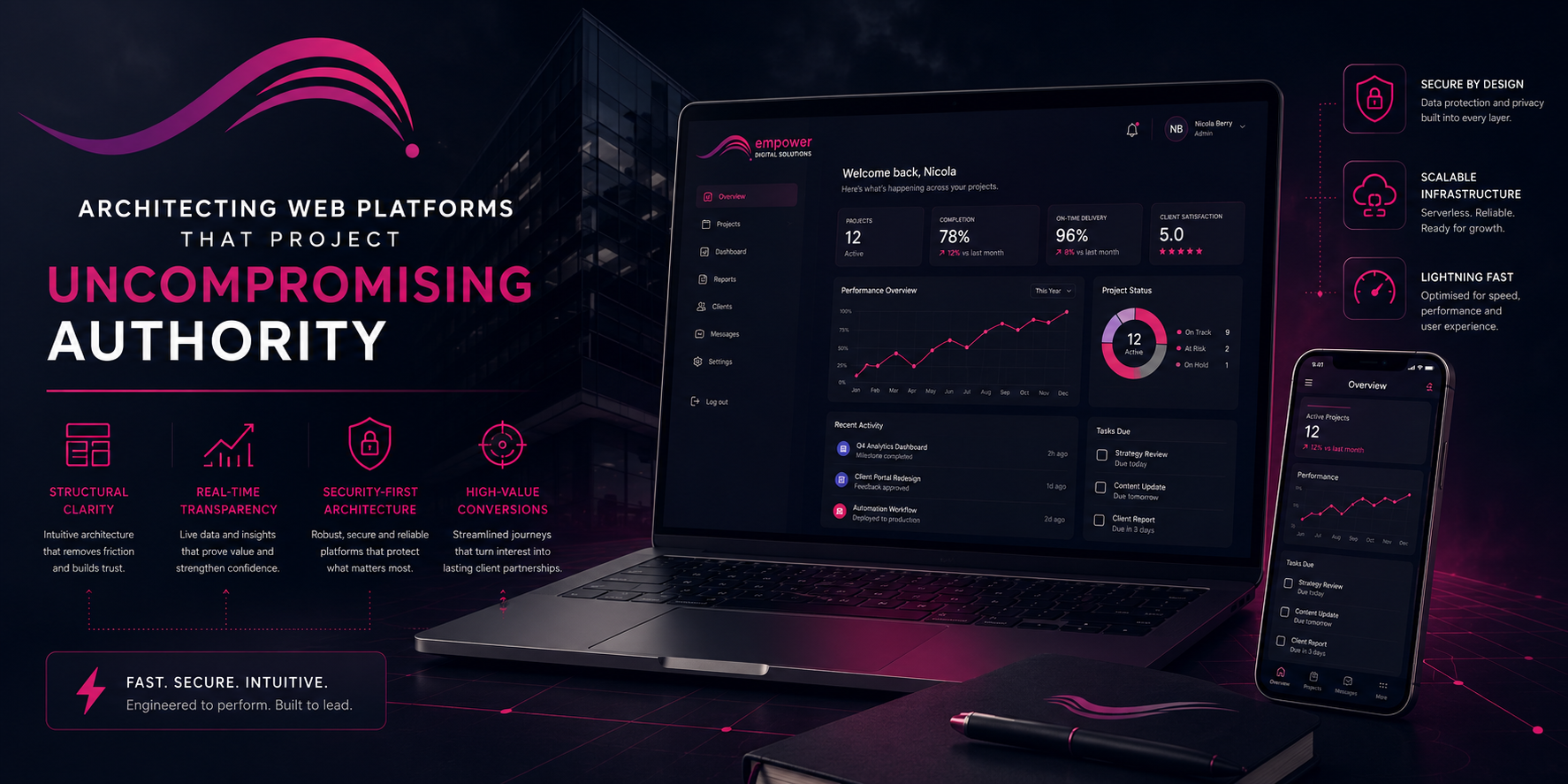
Discusses structural clarity in web portals to eliminate friction, real-time data visualization as a trust engine, and security-first web architecture.
Architecting Web Platforms That Project Uncompromising Authority
Introduction
A company’s web presence is not a passive digital brochure; it is the architectural front door to its market authority. If client portals, landing pages or web assets feel clunky, disorganised or slow, prospective high-ticket clients will assume that operational delivery suffers from identical friction. High-net-worth decision-makers expect intuitive, secure and lightning-fast digital interactions, and every interaction should communicate discipline and precision. Building web platforms anchored in sound logic and clean user experience establishes market authority and drives high-value conversions.
This is particularly true for service businesses whose actual product is expertise rather than a physical thing. When there’s nothing tangible to inspect before purchase, the platform itself becomes the evidence. A polished, considered, technically sound web presence tells a buyer, before a single word is exchanged, that the same standard will be applied to their project.
1. Structural Clarity: Eliminating Cognitive Friction in Web Portals
Visual clarity and intuitive information architecture serve as primary trust signals for corporate buyers.
Cognitive load is a conversion killer. Cluttered layouts and confusing navigation menus force users to expend unnecessary cognitive effort, causing high bounce rates among decision-makers who have neither the time nor the patience to hunt for information. Every extra click, ambiguous label or buried piece of information is a small opportunity for a visitor to give up and leave.
What structural clarity looks like in practice:
- Clean grid layouts – consistent spacing and alignment that make a page easy to scan rather than read line by line.
- Restrained visual hierarchy – one clear primary message per page, with supporting information visibly secondary rather than competing for attention.
- High-contrast typography – text that’s genuinely easy to read at a glance, not merely stylish.
- A three-click evaluation path – structuring the journey so a prospect can evaluate core service offerings, view verified case studies and initiate contact within three clicks, without needing to hunt through submenus or scroll past irrelevant content.
Navigation as a statement of intent. A simple, well-labelled navigation structure implies a business that understands its own offering clearly enough to explain it simply. Confusing menus, by contrast, often signal (correctly or not) an unclear internal understanding of the service being sold. Structural clarity, in other words, is doing double duty: it removes friction for the visitor and it silently communicates operational maturity at the same time.
2. Real-Time Data Visualisation as a Trust Engine
Presenting dynamic performance data directly within client portals converts abstract promises into verifiable proof.
Moving beyond static reporting. Traditional service relationships often rely on periodic status emails or slide-deck updates, both of which put the burden of communication on the provider and leave the client with an outdated picture between updates. Integrating custom data visualisation modules into web platforms allows clients to track project progress, KPI benchmarks or operational metrics in real time, rather than waiting to be told.
How this typically works technically. Utilising modern front-end frameworks, such as Next.js or React paired with a charting library like Chart.js or Recharts, ensures interactive dashboards render instantly on all devices, from a desktop in the office to a phone on a train. Data can be pulled live from underlying systems (project management tools, databases or automation platforms) so the dashboard reflects genuine current state rather than a snapshot from last week’s export.
Why this builds trust faster than words can. Transparent, real-time data reporting builds institutional trust, reduces routine status check emails, and reinforces the value already being delivered, often in ways the client wouldn’t otherwise notice day to day. It also shifts the client relationship from one based on reassurance (“trust us, it’s going well”) to one based on evidence (“see for yourself”), which is a considerably stronger position for a service provider to occupy.
A secondary benefit: reduced admin overhead. Every dashboard view that answers a question a client would otherwise have emailed to ask is time returned to the business, making this as much an operational efficiency play as a trust-building one.
3. Security-First Architecture for High-Value Service Providers
Protecting client data and maintaining zero downtime is essential for preserving brand authority, and increasingly, it’s a baseline expectation rather than a differentiator.
The hidden cost of bloated platforms. Relying on bloated, plugin-heavy content management systems introduces security vulnerabilities and performance bottlenecks, often invisibly, until something breaks or is compromised. Each additional plugin is a separate maintenance burden and a separate potential attack surface, and the cumulative risk across a typical plugin-heavy site is easy to underestimate.
A leaner, more deliberate alternative. Adopting custom serverless architecture, strict content security policies and robust row-level security, for example using a platform like Supabase with PostgreSQL, protects sensitive corporate information while keeping the overall system smaller and easier to reason about. Fewer moving parts generally means fewer places for something to go wrong.
What this signals to enterprise buyers. A secure, highly resilient web application signals to enterprise clients that a firm prioritises data privacy and operational rigour, which matters disproportionately for buyers in regulated industries or those handling sensitive information of their own. For many corporate procurement processes, basic security posture is now a qualifying question before commercial terms are even discussed.
Practical baseline measures worth highlighting to prospective clients:
- Encrypted data in transit and at rest.
- Row-level security so users only ever see data they’re authorised to see, rather than relying on the application layer alone.
- Clear data retention and access policies, ideally documented and available on request.
- Genuine uptime monitoring, not just an assumption that “it’s usually fine”.
4. Why Structural and Technical Authority Also Improves Search Visibility
The same architectural decisions that build trust with a human visitor also tend to be rewarded by search engines, which is worth understanding as a secondary benefit rather than a separate project.
- Clear information architecture with sensible heading structure and internal linking helps search engines understand what a site is about and for whom, which matters most for problem-based searches rather than brand-name searches.
- Fast, lightweight, plugin-light architecture tends to outperform bloated CMS builds on Core Web Vitals, which factor into search ranking.
- Genuine technical depth in the content itself, such as explaining real architectural choices rather than repeating generic marketing language, tends to perform well for specific, high-intent search terms because it matches what a technically literate buyer is actually searching for.
- Custom-built platforms are inherently more crawlable and controllable than heavily plugin-dependent sites, where third-party code can introduce render-blocking scripts search engines penalise.
In short, the qualities that make a platform feel authoritative to a prospective client (clarity, speed, evident technical care) are largely the same qualities that help that platform get found by the right prospective clients in the first place.
Frequently Asked Questions
Why does website security matter for conversion, not just data protection? Increasingly, security posture is a qualifying factor in enterprise procurement, checked before commercial discussions begin. A visibly secure, well-architected platform removes a potential objection before it’s even raised.
Do clients actually use real-time dashboards, or is this just a nice-to-have? Where implemented well, dashboards reduce the volume of routine status enquiries significantly, because clients can self-serve the answer to “how is this going” at any time, rather than waiting for a scheduled update.
Is a custom-built platform always more secure than an off-the-shelf CMS? Not automatically, but a smaller, more deliberately built system generally has a smaller attack surface and fewer unmaintained third-party dependencies than a plugin-heavy CMS, which reduces risk in practice even if either approach can be secured properly with the right expertise.
How many clicks should it take a prospect to reach a contact point? Three is a useful working target: enough to allow for a considered evaluation of services and proof points, but not so many that a time-poor decision-maker gives up before reaching the point of contact.
Conclusion
Architecting web platforms that command authority requires combining visual restraint, real-time data transparency, and security-first engineering, applied consistently rather than as isolated features. By eliminating cognitive friction and demonstrating technical precision throughout, businesses establish market authority, improve their discoverability for the buyers actively searching for solutions, and secure lasting corporate client relationships.
Digital Sovereignty Audit
Step 1 of 5
Can you update your homepage text yourself in under 60 seconds without emailing anyone?
Ready to build your Digital Engine?
Stop letting your website be a brochure. Let's turn it into a revenue-generating asset.
Book a Strategy Call