From Spreadsheets to a Single Source of Truth: The Power of Custom Data Management
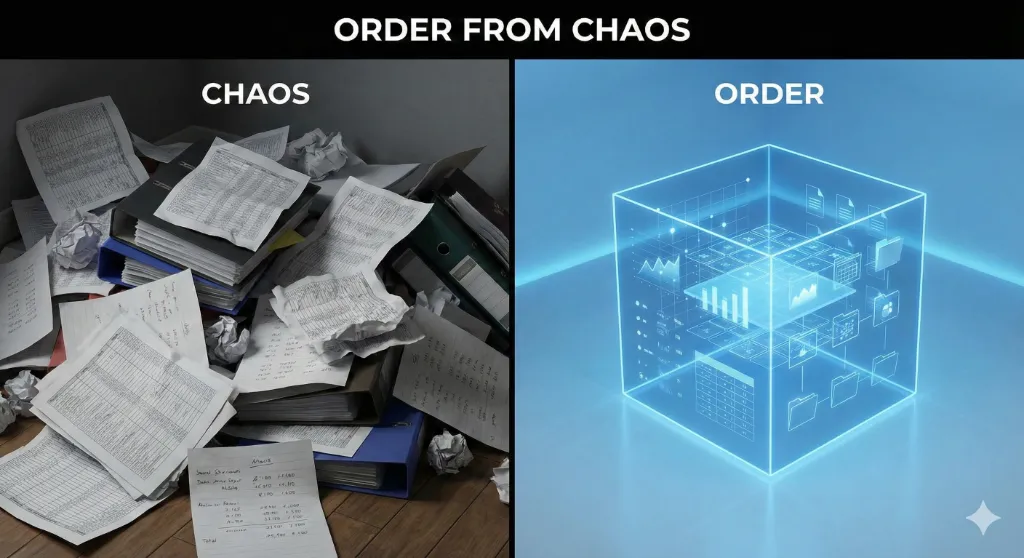
Growing businesses often drown in data. Learn why Excel is holding you back and how moving to a centralised, custom database can revolutionise your operations.
Every successful small business starts the same way: with a spreadsheet.
It’s free, it’s flexible, and it’s easy. You use it to track inventory, client lists, or project status. It works perfectly… until it doesn’t.
There comes a tipping point in every company’s growth where the spreadsheet goes from being a helpful tool to a dangerous liability. We call this the “Spreadsheet Ceiling”.
If you are currently managing your business from a file named Inventory_Final_v3_REAL_PLEASE_USE.xlsx, you have likely hit that ceiling.
Here is why upgrading to a Custom Database (or “Single Source of Truth”) is the most critical operational shift you can make.
The 3 Fatal Flaws of Spreadsheets
1. The “Version Control” Nightmare
You email the spreadsheet to your warehouse manager. He updates it. Meanwhile, your sales rep updates her copy. Now you have two versions of the truth. Who is right? Did you just sell an item you don’t have in stock? Without a centralised database, data integrity is impossible.
2. Lack of Access Control
In an Excel sheet, it’s usually all-or-nothing. If you share the file, they see everything. Do you want your junior warehouse packer seeing your profit margins? Do you want your freelance sales rep seeing your entire client database? A database allows for Role-Based Access Control (RBAC). You decide exactly who sees what.
3. Fragility (The “Human Error” Factor)
It takes one accidental keystroke to delete a formula that powers your entire pricing model. Spreadsheets are passive; they don’t stop you from making mistakes. They don’t warn you if you enter “Banana” into a “Phone Number” field.
The Solution: A Relational Database
Moving to a custom web-based application backed by a SQL database (like PostgreSQL or Supabase) solves these problems instantly.
It brings your data to life.
Here is what a custom data management system looks like in practice:
1. The “Single Source of Truth”
Your data lives in the cloud, not on a laptop. Whether your staff are in the office, in the warehouse, or on the road, they are all looking at the exact same live data. If a salesperson sells an item, the inventory count drops to 99 instantly for everyone. No more double-selling. No more “Let me check the file.”
2. Intelligent Validation
A bespoke system protects your data.
- It won’t let you create an invoice for a client that doesn’t exist.
- It formats phone numbers automatically.
- It alerts you if a profit margin drops below 10%. The system acts as a guardrail, ensuring your business data remains clean and usable.
3. Automation Triggers
A spreadsheet sits there waiting for you to look at it. A database acts. You can program logic directly into your data:
- “If Stock Level < 5, Email Supplier automatically.”
- “If Invoice is 7 days overdue, SMS Client.”
- “If Project Status = Complete, Generate PDF Warranty.”
4. Specialised Views (Dashboards)
Instead of a wall of 5,000 rows, you can build custom interfaces for different team members.
- The Owner: Sees a high-level graph of monthly revenue.
- The Warehouse: Sees a simple list of “Items to Pack Today.”
- The Client: Sees a portal with their order history. Everyone interacts with the same data, but through a lens designed for their specific job.
Case Study: The “Paperless” Warehouse
We recently worked with a logistics firm that ran their warehouse on clipboards and Excel.
- Problem: Drivers would take stock, write it down, and hand the paper to admin. Admin would type it into Excel. Typos were rampant. Stock was always wrong.
- Solution: We built a simple mobile web app.
- Workflow: Drivers scan a QR code on the pallet with their phone. They tap “Load”. The database updates instantly.
- Result: Admin hours reduced by 90%. Stock accuracy hit 99.9%.
Conclusion
Data is the lifeblood of your modern business. If your blood is flowing through leaky, fragile pipes (spreadsheets), your business is anemic.
Upgrading to a custom database isn’t just an “IT” decision; it is a strategic move to secure your operations and prepare for scale.
Ready to migrate your spreadsheets to the cloud? Contact Us for a data architecture consultation.
Digital Sovereignty Audit
Step 1 of 5
Can you update your homepage text yourself in under 60 seconds without emailing anyone?
Ready to build your Digital Engine?
Stop letting your website be a brochure. Let's turn it into a revenue-generating asset.
Book a Strategy Call